
It is 7 AM in your lobby. A guest walks up to the desk and asks a question in Japanese.
Your receptionist smiles. She apologizes. She reaches for her phone and opens a translation app. The guest waits while she types. He repeats himself, slower this time. Somewhere in that pause, something shifts. He arrived as a person who was expected. He is now a problem being processed.
He will not complain. He will just ask fewer questions for the rest of his stay. And in three days he will write a review in Japanese. Machine translation will tell you roughly what it says. It will not help you answer it in a way that reads as sincere to the next Japanese traveler screening your property.
This Is Not a Hiring Problem
The instinct is to treat language as a staffing gap. Hire a receptionist who speaks German. Add a night porter with some Mandarin. Post the next opening with "third language a plus."
It rarely works, and most hotel managers in Europe already sense why. A hotel in Vienna, Amsterdam, or Lisbon serves guests from a dozen countries before breakfast. Almost no candidate speaks twelve languages, and the few who do are not applying for front desk roles. No schedule puts the right speaker at the desk at the right moment. You could hire the most talented receptionist on the continent and she would still struggle with the Japanese guest at 7 AM, the German couple at 7:05, and the Portuguese family at 7:10.
This is not a training problem. It is not a budget problem. It is closer to a physics problem: a single human being cannot hold twelve languages and switch between them on demand. The desk itself is the bottleneck, and hiring alone does not remove it.
That also means the problem is structural, not seasonal. It does not fade when the labor market recovers or when interest rates fall. Your lobby will be just as multilingual in ten years. More so, probably.
What the Language Barrier Actually Costs
The visible cost is the queue. Every translated exchange takes noticeably longer — type, wait, rephrase, repeat — so check-in slows and the line grows behind it.
The invisible costs are larger.
Guests who struggle to be understood stop asking questions. The question they never ask is the late checkout they would have paid for, the spa slot they would have booked, the restaurant table that stays empty. The upsell does not fail. It never happens.
Small problems stay silent until they become complaints. A guest who cannot easily say "the air conditioning is broken" on day one says it in a review on day four — in a language your team can machine-translate, but cannot answer well or fast. Your rating drifts in markets you barely monitor.
And your staff carries the weight. Nobody enjoys apologizing to a guest they cannot help. Repeat that moment ten times a shift and it becomes one more quiet reason people leave a job that already struggles to keep them.
Now Imagine the Same Morning
Same lobby. Same 7 AM. The Japanese guest walks up and asks his question.
The answer comes back in Japanese. Not after a pause, not through an app held between two embarrassed people. From the first word. He asks a follow-up. He gets a real answer, because the thing he is talking to knows this hotel: the breakfast hours, the parking rules, the checkout policy, the way to the metro.
The German couple behind him gets German. The Portuguese family gets Portuguese. Nobody is asked to repeat themselves. Nobody is processed.
And your receptionist? And your reception team? They are helping the guest whose flight was cancelled and whose child is crying—because that is the kind of situation that truly needs a human being.
That is the real question hiding under the language barrier. Not "how do we hire someone who speaks more languages," but "which parts of this role require a human at all?" Answering the same forty questions in twenty languages does not. Reading a stressed guest's face and bending a rule for them absolutely does.
How a Multilingual Hotel Concierge Actually Works
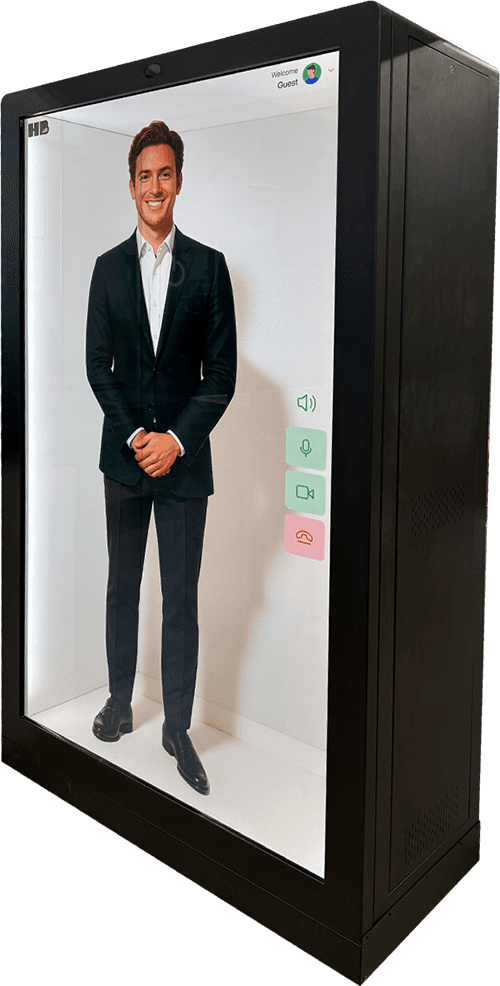
This is what HumanBeam builds: an AI concierge with a hand-crafted 3D avatar, standing in your lobby on an ordinary screen, a BeamBox, or a Looking Glass holographic display — or living on your website — running a persona built on your hotel's own knowledge base.
It greets the guest in their language and switches languages mid-conversation if the guest does. It speaks more than 20 languages, including Japanese and Hindi. It answers from your information, not from the open internet, so the breakfast hours it gives are your breakfast hours. And it works as a true 24/7 hotel concierge: 2 AM sounds exactly as good as 2 PM, because there is no end of shift.
Just as important is what it does when it should not answer. A complaint, a payment dispute, a request outside its knowledge — the avatar does not improvise. Its job ends where judgment begins: it lets the guest know a member of your team will take it from there, instead of guessing. The boundary between the avatar's work and your team's work is part of the design, not a failure mode.
Your team stops being a translation bottleneck and starts doing the work you actually hired them for.
What About Guest Data?
In Europe, this is where most hotel AI conversations quietly die: what happens to guest data?
It is the right question — GDPR made it the first question any hotel group asks — and the platform's architecture answers the biggest part of it. Every organization on the HumanBeam platform runs in a fully partitioned org: your avatars, your knowledge base, and your guardrails are never shared with any other client. And sensitive data can run securely inside your own environment, which for many hotel groups is the difference between an interesting idea and an acceptable one.
The rest — what is stored, for how long, and under which agreements — depends on how your deployment is configured. Those are exactly the questions to bring to a demo, and you should ask them the way your data protection officer would. A serious platform should welcome that conversation. We do.
What to Measure Before You Believe Any of This
A vendor article is not evidence — including this one. If you pilot a multilingual concierge, ours or anyone's, measure five things over four weeks:
Conversations handled, by hour of day
Languages actually used by guests
Share of questions resolved without staff involvement
Handovers to staff, and whether they worked smoothly
Upsell prompts accepted and bookings initiated
If the concept works for your property, these numbers will show it within a month. If they don't, you have lost four weeks and gained a precise map of what your guests actually ask.
The Desk Was Never Meant to Be a Wall
Hotels have spent decades trying to solve the language barrier by improving the person behind the desk. The lesson of every multilingual lobby in Europe is that the person was never the problem.
You cannot train one human to be twelve. But you can change what stands at the desk, so that the human next to it is finally free to do what only humans can.
The guest from the opening of this article walks in tomorrow morning. The only question is whether he gets a translation app or a welcome.
The Next Step Takes Twenty Minutes
The fastest way to evaluate a multilingual concierge is not another article. It is a conversation about your lobby.
Request a demo for your property. Bring your FAQ list, the languages your guests actually speak, and your hardest data-protection questions — we will show you what a persona built on your hotel's knowledge looks like →
AI Concierge for Modern Hospitality
Enhance guest satisfaction while cutting operational costs. HumanBeam’s AI Concierge delivers personalized service 24/7, from seamless check-ins to local recommendations. Empower your staff to focus on high-value tasks while our intelligent avatar handles routine requests, guest inquiries, and upsells that drive revenue and loyalty across every property.
AI Virtual Patient Simulation for Healthcare Training
Prepare students and clinicians with lifelike, conversational virtual patients powered by HumanBeam’s 3D AI engine. Run standardized scenarios for history taking, triage, empathy training, and clinical reasoning, all with natural dialogue and emotion. Programs gain consistent practice, objective scoring, and reduced reliance on expensive live actors.
AI Front-Desk & Nurse Assistant for Healthcare
Streamline patient intake and reduce staff workload with HumanBeam’s AI-powered holographic concierge. From check-ins to wayfinding, our compliant virtual assistant ensures every patient receives fast, accurate, and compassionate service. Free up your team for what truly matters — delivering quality care with efficiency, empathy, and measurable operational savings.
AI Holographic Hosts for Events & Conferences
Transform event engagement with HumanBeam’s holographic AI presenters. From welcoming attendees to showcasing sponsors and products, our Event Concierge AI captivates audiences while generating measurable ad revenue for organizers. Deliver unforgettable experiences, streamline logistics, and boost ROI with intelligent, real-time interactions that bring events to life.