
Every front line has already met automation twice. The first time it arrived as a kiosk. The second time it arrived as a chatbot. Both promised the same thing: serve more people with fewer staff. And both left the same scene behind: a customer tapping through menus, sighing, and looking around for a human.
If you run a hotel lobby, a clinic front desk, a retail floor, or an event entrance, you have watched this scene. The question is no longer whether to automate the front line. It is which format — kiosk, chatbot, or conversational AI avatar — your customers will actually use.
What Is a Conversational AI Avatar?
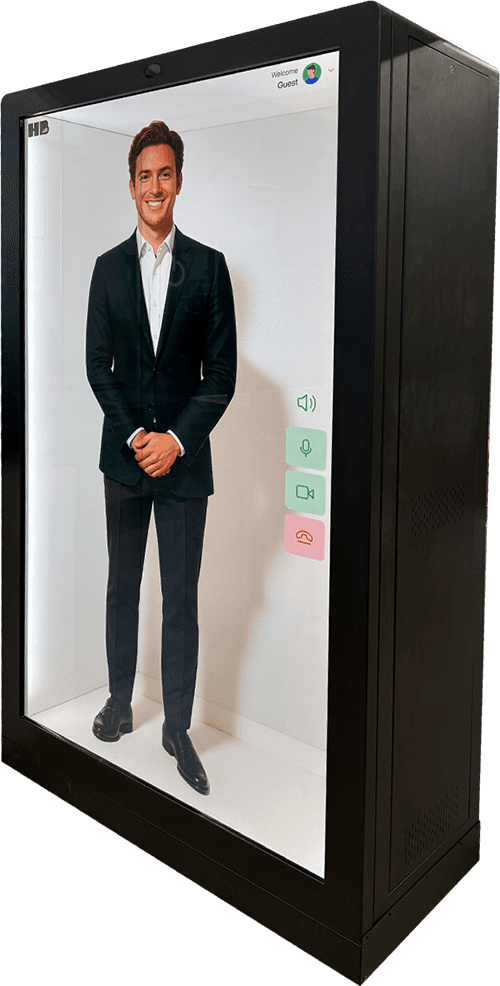
A conversational AI avatar — sometimes called a digital human or an interactive AI avatar — is a lifelike 3D character with a face and a voice that holds real-time spoken conversations with customers. It runs on an ordinary screen, a website, or a holographic display, draws its answers from a company-approved knowledge base rather than the open internet, and leaves complex cases to staff.
The shortest way to place it: kiosks take taps, chatbots take text, an avatar takes conversation.
Two Waves of Automation — an Honest Scorecard
Kiosks are excellent at structured tasks, and it is worth saying so plainly: for payments, identity checks, printing, and high-volume standardized transactions, a kiosk is still the best tool in the building. Airlines did not adopt them by mistake. The failure mode starts where the menu ends. The moment a customer asks something the designers did not anticipate, the interaction collapses — there is no negotiation with a touchscreen. The customer abandons the task or joins the queue for a human, which is exactly the queue the kiosk was installed to shorten.
Chatbots solved a different problem, and solve it well: they scale almost infinitely, cost close to nothing per conversation, and are genuinely good at asynchronous text support on web and mobile — order status, opening hours, password resets. The failure mode is conversational depth. The bot answers the question the company scripted, not the question the customer asked. Text on a screen carries no warmth, no attention, no accountability. Many people type "agent" as their first message. That is not adoption. That is evasion.
Here is the hidden cost of both waves. When automation fails politely, nobody logs it. The guest who could not find late checkout in the kiosk menu does not file a complaint. The patient who gave up on the clinic chatbot does not explain why they called instead. Staff quietly absorb the overflow, service hours stay capped by payroll, and multilingual coverage remains a wish-list item. Doing nothing does not keep costs flat. It keeps them hidden.
How the Three Formats Compare
The honest way to choose is to compare the formats against what front-line work really demands: handling ambiguity, speaking the customer's language, and making the customer feel received rather than processed.
Criterion | Kiosk | Chatbot | Conversational AI avatar |
Best use case | Standardized transactions: payments, check-in printing, ID verification | High-volume asynchronous text support on web and mobile | Spoken, ambiguous, multilingual front-line conversations |
Input type | Menu taps on a touchscreen | Typed text | Natural speech (with text fallback) |
Handles ambiguity | No — off-menu requests dead-end | Partially — within scripted intents | Yes — open questions within its knowledge base |
Languages | Fixed UI translations | Often multilingual text | Real-time multilingual speech; switches mid-conversation |
Customer experience | Self-service | Support ticket | Digital human customer service — being received |
Privacy | High (private screen) | High (own device) | Spoken in shared space — placement and layout matter |
Accessibility | Touch-dependent | Text-dependent | Voice-first; needs a text/touch fallback |
Hardware cost | High (dedicated unit) | None | From an ordinary screen to a holographic display |
Integration effort | Medium | Low to medium | Medium — knowledge base first, booking systems optional |
Human handoff | Join the queue | An "agent" button, if you find it | Built-in: complex cases go to staff by design |
The pattern is consistent. Kiosks win on transactions. Chatbots win on volume. The avatar wins on conversation — and conversation is what the front line is for.
Where an Avatar Is Not the Answer
A fair guide has to say this part out loud.
If your front line is ninety percent payments and printing, buy a kiosk. If your volume is asynchronous, text-based, and mobile, a chatbot may be all you need. And an avatar has real constraints to design around: it speaks and listens in a shared space, so a noisy lobby or a privacy-sensitive question needs thoughtful placement and a text fallback; it takes more integration effort than a chatbot, because its value depends on the knowledge behind it; and some visitors will always walk past it to a human — which is fine, because the human is still there.
In practice, the strongest front lines mix formats: a kiosk for the transaction, an avatar for the conversation, a human for the exception. The question is not which single tool to buy. It is which layer of your front line is currently uncovered — and for most businesses, the uncovered layer is conversation.
Now Imagine the Third Option
Now imagine the same lobby at 3 AM. A guest walks up. Instead of a menu tree, someone greets them. A face turns toward them. A voice answers in the guest's own language, takes a half-formed question, and resolves the request in one exchange. No queue, no script maze, no "please hold for the next available agent."
The guest does not think about the technology at all. They think: someone was there for me. That feeling, available at every hour and in every language, has always been the most expensive thing in service. Until now, the only way to buy it was headcount.
Where a Conversational AI Avatar Fits
HumanBeam was built for this gap. It gives businesses the third option: an AI-powered digital human — a lifelike avatar with a face and a voice that talks with customers in real time, on an ordinary screen in a lobby, on a website, or on a Looking Glass holographic display where the avatar stands in the room as a three-dimensional figure.
Here is what it does differently.
A kiosk needs the request to fit a menu. The avatar does not. A guest can say, "I land at midnight, can I still check in?" — the avatar understands the question and answers from the hotel's own knowledge; connected to your booking system, it can work with the reservation details too.
A chatbot answers in silent text. The avatar answers with a face and a voice, and in our demos that difference visibly changes behavior: people tend to explain their situation in full sentences, the way they would to a person, instead of typing keywords and hunting for the "agent" button.
One avatar covers many roles. Connected to your knowledge base — and, where needed, your booking systems — it works as an AI receptionist in a clinic, an AI concierge in a hotel, or an event host at a conference entrance. It speaks more than 20 languages, including Japanese and Hindi, and switches language when the customer does. It works around the clock, and the last conversation of the night sounds as good as the first.
None of this replaces your team. It extends them. The avatar takes the routine questions that fill every front-desk shift — directions, opening hours, check-in, bookings, FAQs — and your people keep the cases where judgment and empathy decide the outcome.
The Real Choice
Front-line automation was never about removing people from the front line. It is about making a human-quality welcome available at every door, in every language, at every hour.
Kiosks automated transactions. Chatbots automated answers. A digital human automates presence. That is a different category of value, because presence is what customers came to the front line to find.
What This Means for Your Business
For decision-makers, the shift translates into concrete outcomes. Service hours stop being limited by shift schedules. Multilingual coverage stops depending on who happens to be on duty. Every guest, patient, or visitor gets a consistent greeting and consistent answers — something even the best-trained human team cannot guarantee across every shift. And the pressure on staff drops, because the avatar absorbs the routine flow instead of adding an escalation queue to it.
How large the effect is depends on the use case and, above all, on the quality of the knowledge behind the avatar. That is why a HumanBeam deployment starts with your content, not with the hardware: our team builds the persona around your actual FAQ, your systems, and your escalation rules — so the avatar answers like your best-trained employee on their best day, every day.
Back to the Lobby
Return to that customer at the kiosk, tapping through menus and looking for a human. In the old model, the story ends with a queue. In the new one, it ends with a conversation: a lifelike AI concierge that heard the question, understood it, and solved it, at an hour when no front desk was staffed.
Kiosk, chatbot, or avatar is not really a three-way tie. It is a question of what your front line is for. If the answer includes making people feel received, it is worth seeing what a conversational AI avatar could look like in your space.
Request a 20-minute walkthrough. We will sort your front-line volume into kiosk-shaped, chatbot-shaped, and conversation-shaped work — and show where an avatar pays off first.
AI Concierge for Modern Hospitality
Enhance guest satisfaction while cutting operational costs. HumanBeam’s AI Concierge delivers personalized service 24/7, from seamless check-ins to local recommendations. Empower your staff to focus on high-value tasks while our intelligent avatar handles routine requests, guest inquiries, and upsells that drive revenue and loyalty across every property.
AI Virtual Patient Simulation for Healthcare Training
Prepare students and clinicians with lifelike, conversational virtual patients powered by HumanBeam’s 3D AI engine. Run standardized scenarios for history taking, triage, empathy training, and clinical reasoning, all with natural dialogue and emotion. Programs gain consistent practice, objective scoring, and reduced reliance on expensive live actors.
AI Front-Desk & Nurse Assistant for Healthcare
Streamline patient intake and reduce staff workload with HumanBeam’s AI-powered holographic concierge. From check-ins to wayfinding, our compliant virtual assistant ensures every patient receives fast, accurate, and compassionate service. Free up your team for what truly matters — delivering quality care with efficiency, empathy, and measurable operational savings.
AI Holographic Hosts for Events & Conferences
Transform event engagement with HumanBeam’s holographic AI presenters. From welcoming attendees to showcasing sponsors and products, our Event Concierge AI captivates audiences while generating measurable ad revenue for organizers. Deliver unforgettable experiences, streamline logistics, and boost ROI with intelligent, real-time interactions that bring events to life.